

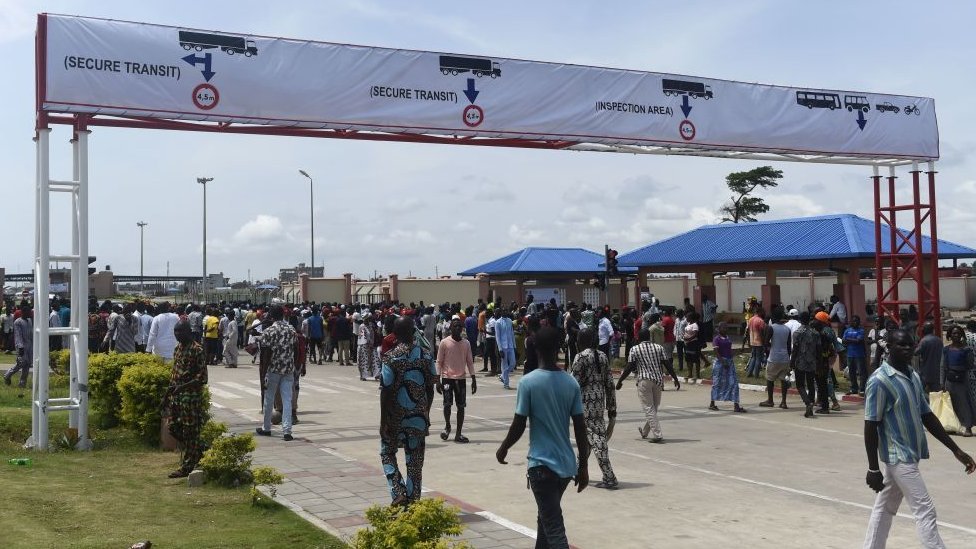
The President of the ECOWAS Commission, Dr. Omar Touray, has raised alarm over the dilapidated state of facilities at the Nigeria-Benin Republic border, describing it as a major threat to the region’s free movement and trade agenda.
During a visit to the Seme-Krake border on Wednesday, Touray decried the failure of essential infrastructure such as scanners, lighting systems, and bridges, despite the site being one of the busiest transit points in West Africa.
“This is one of the busiest and most strategic border posts in West Africa,” he said. “And yet, we are faced with expensive facilities… that are simply not working. That is unacceptable.”
Touray criticised the lack of maintenance by member states, stressing that ECOWAS cannot be responsible for basic upkeep. “If a lightbulb goes out, ECOWAS should not be called to replace it. Member states must step up and take ownership,” he said.

He also condemned the proliferation of checkpoints along the corridor, saying it contradicts the ECOWAS free movement protocol. “Why do we have multiple customs and immigration posts for the same corridor? It frustrates travellers, delays trade, and creates opportunities for corruption.”
Touray urged transparency and accountability from border officials, warning against unofficial payments. “We have received troubling reports of citizens being asked to pay without receipts. This damages trust. If any fee is legitimate, it must be receipted. Period!”
At the border, Nigeria’s Customs Controller, Ben Oramalugo, confirmed several operational setbacks, including faulty scanners, power outages, and lack of water. “Since I reported here on February 12, the scanners have remained non-functional… There is no light in the pedestrian passage, no roofing, and no water in the offices.”
He further noted, “We are not connected to Nigeria’s national grid. We depend entirely on Benin for electricity.”
Oramalugo also raised concerns about double taxation and urged reforms in transit policies. “Goods taxed in Benin are taxed again in Nigeria. Importers are avoiding this corridor.”
Language barriers were another key issue. “I cannot even communicate with my Beninese counterpart,” Oramalugo said, calling for mandatory bilingual education across ECOWAS countries.
Dr. Touray pledged to deliver a comprehensive report with recommendations for improving infrastructure, reducing delays, and ensuring secure but seamless cross-border movement. “If we cannot move people and goods freely, we cannot build a truly integrated region,” he stated.
Nigeria’s Permanent Representative to ECOWAS, Ambassador Musa Nuhu, emphasised the importance of the Seme border to regional integration. “If free movement is working in West Africa, it is in this border that we will be able to find out.”
He revealed that the Nigerian government had approved the establishment of a Presidential Task Force to dismantle excessive checkpoints along the Seme-Badagry corridor.

